


The Automobile Recycling Law requires automobile manufacturers and importers to collect and recycle the three designated items from end-of-life vehicles Fluorocarbons, and automotive shredder residue (ASR).
Our organization was established in January 2004 to receive commissions from automobile manufacturers and importers Fluorocarbons —two of the three designated items—and to ensure the proper, reliable, and efficient collection and recycling (including destruction Fluorocarbons ) of these materials.
Regarding Fluorocarbons and airbags, we centrally manage collection and oversight on behalf of all automobile manufacturers and importers, coordinating with approximately 4,000 recycling operators nationwide.
We facilitate smooth operations by securing economies of scale in logistics and information systems, reducing recycling fees that burden vehicle owners, and establishing a single point of contact for Fluorocarbons, Fluorocarbons destruction operators, vehicle dismantlers, and airbag recyclers.
Additionally, since fiscal year 2016, we have been entrusted with back-office operations related to ASR by the Automotive Shredder Residue Recycling Promotion Team (ART).
Furthermore, in recent years, in response to changes in the environment surrounding the automotive industry, Lithium-ion battery the Lithium-ion batteryAdvanced mobility and are also engaged in businesses aimed at the appropriate recycling of Lithium-ion battery (LiB) Advanced mobility.
Fluorocarbons

Airbags

ASR

Under contract with the Automobile Shredder Residue Recycling Promotion Team (ART), the following operations are carried out on behalf of the ART.
Lithium-ion Battery

Advanced Mobility

Message
Massage from the President
In order to ensure the implementation of the "Retrieval and destruction of fluorocarbons and airbags" mandated by the Automotive Recycling Law, the Corporation has been promoting the "establishment, operation, and management of a recycling system including efficient joint collection" on behalf of automobile manufacturers and others.
Furthermore, for Automobile Shredder Residue (ASR), the Corporation was entrusted with the back-office operations of the Automobile Shredder Residue Recycling Promotion Team (ART) in 2016 and is involved in the proper and smooth processing of all three designated collected items for automobile recycling.
The automotive industry has been undergoing dynamic environmental changes on a global scale in recent years. In particular, the challenges of carbon neutrality and the circular economy are now essential. The accelerating shift to electrification and the growth of plastics recycling and strategic resources are expected to bring about a significant change in the automotive recycling world.
On the other hand, the automotive recycling industry is facing a number of challenges that cannot be addressed by the conventional domestic-focused automotive recycling alone, such as the rapid increase in the number of foreign dismantlers, the aggressive entry of foreign recyclers into the Japanese market, and the increasing outflow of used lithium-ion batteries overseas. Therefore, the Corporation recognizes that efforts based on global resource recycling will become increasingly important.
The Corporation is proud that its major strength lies in its expertise in automobile recycling, which has been cultivated under the Automobile Recycling Law. We believe that it is our mission to make the most of this strength and pioneer the future of automobile recycling. We have already started to build a recycling system for electric mobility, which is not covered by the Automobile Recycling Law, and we will continue to contribute to automobile recycling in the future in response to the demands of the times.
On January 1, 2024, we will celebrate the 20th anniversary of our establishment and have formulated a new mission, vision, and values as our management policy. Under the new policy, we are determined to achieve further growth as a united staff. We hope you will look forward to an upgraded "Japan Auto Recycling Partnership".
As a partner connecting everyone involved in automotive recycling, we ask for your continued understanding and cooperation in our activities.
Representative Director
Kenji Dosaka
Profile
About JARP
| Corporate Name | Japan Auto Recycling Partnership (JARP) |
|---|---|
| Japan Auto Recycling Partnership(JARP) | |
| Established | January 1, 2004 |
| Funds | 32.5 million JPY |
| Members |
Isuzu Motors Limited Suzuki Motor Corporation Daihatsu Motor Co., Ltd. Toyota Motor Corporation Nissan Motor Co., Ltd. |
| Officers | Representative Director Kenji Dosaka Executive Director Katsutoshi Hashiguchi Director Takashi Minegishi Auditor Taro Kuroda |
| Head office |
16F, Japan Automobile Hall, 1-1-30 Shibadaimon, Minato-ku, Tokyo (MAP) |
| ASR department |
PMO Shiba Daimon 4F, 1-10-18 Shiba Daimon, Minato-ku, Tokyo (MAP) |
| Access |
AccessToei Mita Line 'Onarimon (I06)' Station, Exit A2 or A3, 3-minute walk Toei Asakusa Line / Oedo Line 'Daimon (A09・E20)' Station, Exit A4, A5, or A6, 4-minute walk 8 minutes walk from north exit of hamamatsucho.sta Tokyo Monorail 'Hamamatsucho' Station, 8-minute walk For vehicles, from Shuto Expressway 'Shibakoen' exit, turn right at Onarimon intersection on Hibiya-dori, then turn right at Atago Police Station intersection |
Mission
Our Organization's Mission
Vision
How we want to be
Achieve safety, appropriateness,
efficiency, and cost reduction of the three items in End-of-Life Vehicle Recycling Law
To provide services exceeding expectations to stakeholders (e.g., government, obligated parties, related organizations, and recyclers)
Quick respose to changes in the environment surrounding the automotive society, including lithium-ion batteries and advanced mobility
Promote response to internationalization of Japan automobile recycling by utilizing accumulated on-site know-how, etc.
Value
Our Organization's Core Values
Strict Adherence to Compliance
Sense of Ownership
Speedy Response × Execution Capability
Pursuit of the Essence of Things
Two self-reliant (independent and autonomous) actions
ELV Recycling's
on-site capabilities and professionalism"
Challenge & Innovation
Organization
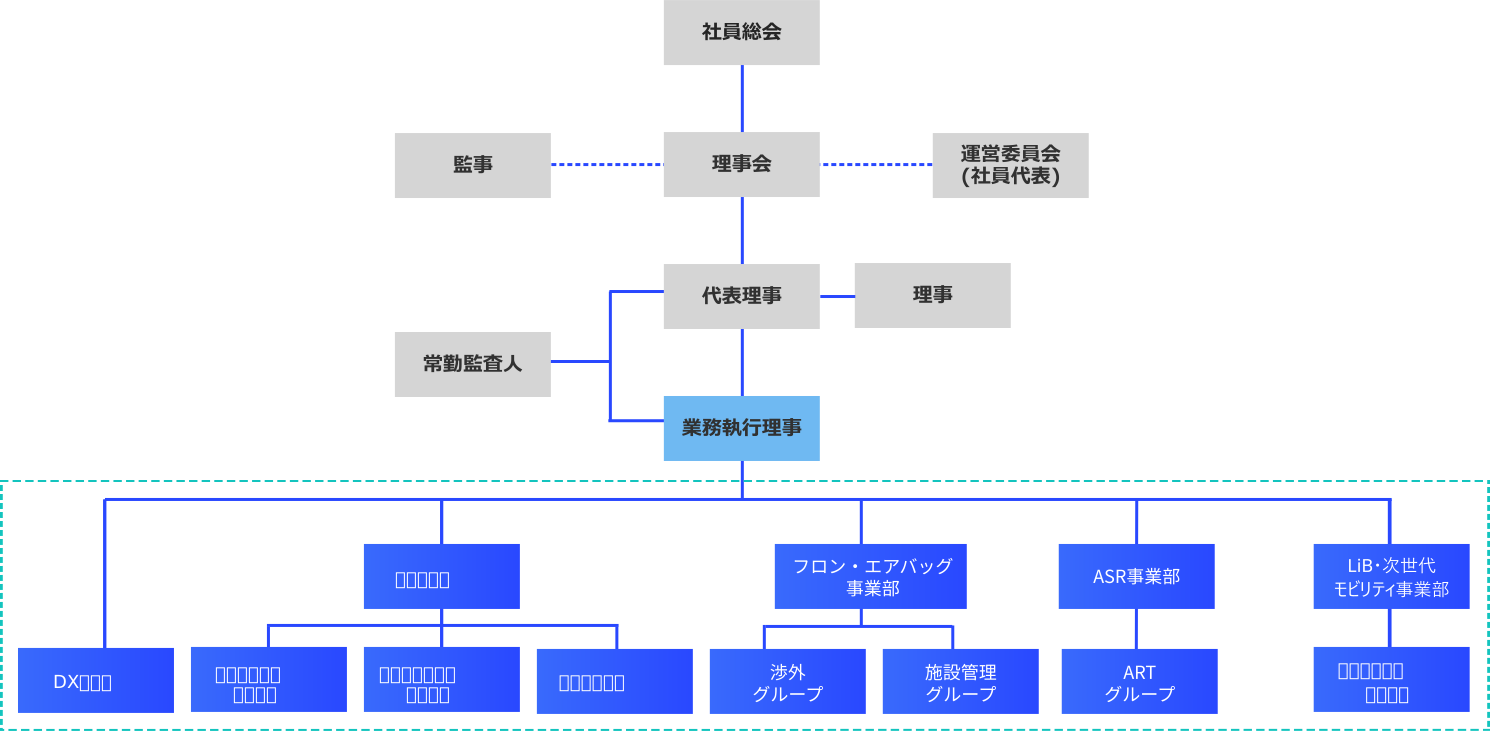
Organizational Chart
To address issues related to end-of-life vehicle recycling, the 'Act on Recycling of End-of-Life Vehicles' (Automobile Recycling Law) was promulgated in July 2002 and fully enforced in January 2005.
Background of End-of-Life Vehicle Recycling Law
History
History of JARP
12 Japan automobile companies and Japan Automobile Impoeters Association established Japan Auto Recycling Partnership Limited Liability Intermediate Corporation (JARP)
End-of-Life Vehicle Recycling Law took effect. *1
Automobile manufacturers and importers entrust us with the handling of fluorocarbons and airbags, among the three items which are required to recycle in the law.
Changed legal status to 'General Incorporated Association' following the abolition of the Intermediate Corporation Act
Established ART department (now ASR department)
Started handling ASR*2
(Back-office operations related to the collection of automobile shredder residue from automobile manufacturers which joines ART (Automobile Shredder Residue Recycling Team), etc. and its recycling)
Established the LiB Division ( Advanced mobility )
Began handling LiB products*3
(Back-office operations related to the collection and recycling of LiB products for automobile manufacturers and other entities participating in the LiB Joint Collection System)
Commencement of Advanced mobility handling
(Back-office operations related to the collection and recycling of Advanced mobility for manufacturers, etc., participating in the Advanced mobility recycling system)
*1 Act on the Recycling of End-of-Life Vehicles
*2 Automobile Shredder Residue: Automotive Shredder Dust
*3 Lithium-ion battery installed in hybrid vehicles, EVs, and Advanced mobility